Frame in Focus: Friendship
This week’s Frame in Focus contemplates a set of Frames that were created to celebrate the friendship between a trio of actresses. As such, friendship has been something that we’ve been musing upon this week in the studio.
At a time in our collective history where social media and digital technology has become a dominant medium of communication, there has been a somewhat ironic societal increase in people feeling isolated. Perhaps this is why friendships – especially female friendships – are becoming a popular focus in many creative endeavours. Shows such as Girls, Broad City and Playing House promote this idea, while books like A Little Life have been received with great acclaim in the literary world. Could it be that we are tiring of those success narratives that stress the importance of our jobs, owning houses and especially our romantic connections, with little regard being given to our social successfulness? Are we becoming more aware of the potential permanence and thus additional value in our friendships by contrast to the sexual, romantic and professional ties that we can now obtain through apps, and can walk away from with relative ease?
The significance and value of friendships has long been remarked upon within philosophy and the arts at large. Aristotle postulated that:
“…without friends no one would chose to live, though he had all other goods.”
There seems to be something that the presence or influence of friends offers up to us that is unique. Yet, pinpointing this and then going on to represent it artistically is less clear-cut. Much like art, the precise form and value of friendships appears to be highly subjective.
In considering friendship relative to art, we attempted to find expressions of friendship within the visual arts. With some surprise, we discovered that although friendship has been attempted in many paintings, there often seems to be an ambiguity in its static depiction; an ambiguity of both subject and dynamic. Many of the paintings we viewed could be interpreted as romantic connections for example. The degree of closeness between those shown is often very hard to gauge. This brings us to question, what might be the challenges of representing friendship in art?
We found enlightenment in a published dialogue between Philosophy Professor, Alexander Nehemas, and Senior Associate Editor for The Atlantic, Julie Beck. In this conversation they propose that paintings usually show isolated behaviours, however friendships are constructed from a great deal of behaviours that are interwoven into an established and mutually understood discourse between people. Friendships can therefore be represented more easily in dramas, theatre and similar mediums that permit facial expressions, body language, and the continued activity of it all. Friendships are action in this sense, actively performed, enacted and re-enacted, often with developments and additions made through time. Capturing friendship in our artwork therefore saw us taking up a significant challenge, but one that we were excited to embrace.
The Friendship Frame Set, as shown on our website, was commissioned by one third of a trio who wished to surprise the other two. Her desire was to create three pieces with us that represented each member of the triad as an individual but that also suggested the inherent depth and power of this collective friendship when brought together.
All three women are Scottish and their Scottish roots were deemed to be a pertinent part of their personhood. We were consequently keen to bring a Celtic essence to the Frame Set, which was clarified as relevant when we discovered that these three women even reference each other as “anam cara” – the Gaelic for “soul friend”. It is their shared belief that their connection goes beyond the realms of typical friendship. Other key factors were the womens’ shared love of horses, their meeting in the National Theatre’s production of Men Should Weep, and a collection of songs that were deemed to highlight shared experiences.
With all of this in mind we got to work in honing a creative treatment that incorporated everything we had learnt about these women and their connection.
We spent considerable time looking into Scottish and Celtic mythology and legend. It was here that we came across several key elements that became integral to the Frame Set.
Primarily, we wanted to draw upon the Kelpie as a focal point. As some may already be aware, these remarkable creatures from Scottish folklore are considered to be shape-shifters. Fittingly, they either appear as beautiful, alluring maidens, or as horse-like animals that represent strength, power and the ethereal. However, excitingly(!), they are both magnificent and have a more ominous streak: they are not to be messed with! The actress commissioning the work was in wholehearted agreement that this held a fitting parallel for three strong and independent young women of today.
We therefore created a central Kelpie head in each actress’s Frame. This is a dynamic paper sculpture and uses the maps of Edinburgh, Glasgow and London relevant to each actress to construct their Kelpie head. We then called upon the scenes and lines from Men Should Weep as was delivered by each of these actresses in the production to create the mane for their horse. As we were enjoying drawing upon the rich imagery of the Celtic, we also opted to have each horse’s eye glinting with the Celtic symbol of friendship, while the knot of sisterhood has been branded onto their necks. Sheet-music waves then lap up from beneath each horse, comprised from the manuscripts of musicians of significance in the women’s shared history. These were inked and layered in acrylic washes.
These paper sculptures then required a backdrop that would appropriately host them. Aware that the three Frames needed to suggest an additional significance when combined, we began to consider the ways in which we could link them visually. In tandem with this, we continued down our route of Celtic investigation and came across the beautiful Ogham script. Ogham is an ancient writing form that has often been discovered around the islands of the Irish Sea. It takes the form of various lines and points that are inscribed upon one greater line. It therefore emerged as a perfect option for us to connect the three Frames.
Amid our discussions and initial consultation, the addresses of the three actresses were noted and we were informed that they themselves had once connected their three homesteads on a London map to create a triangle. With this in mind, we opted to mimic this tringle with each corner being housed within one of the three Frames. The lines of the triangle then offered up a perfect location for us to scroll in Ogham.
Creating Ogham Script
Finished mythical backdrop
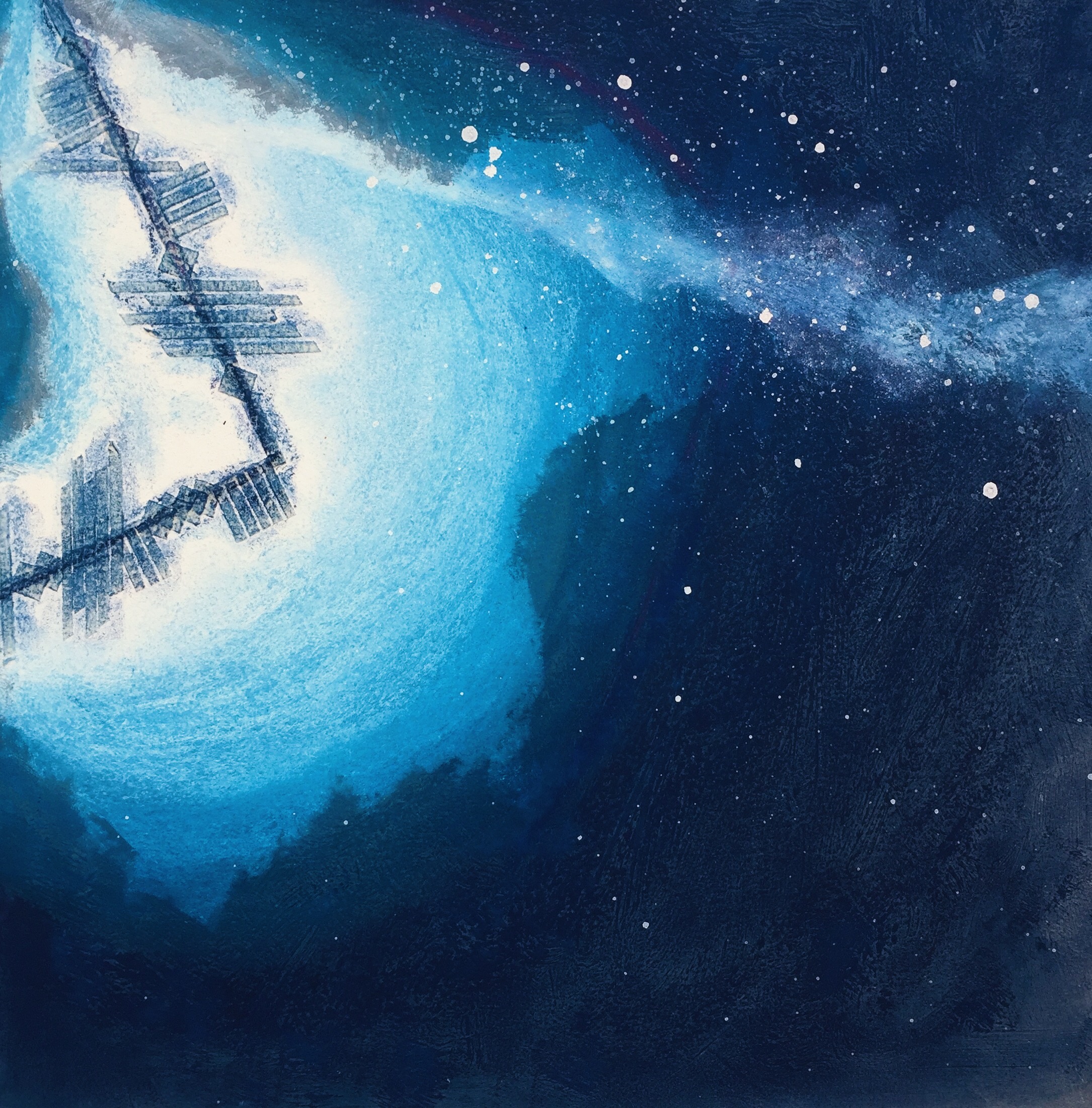
And that is just what we did. Each backdrop is dominated by a corner of this greater triangle. Upon the two lines of this corner is then scrolled in Ogham both “anam cara” and the name of each actress. In-keeping with the ethereal and the mystic, we then created a cosmic landscape around these Ogham corners. Finally, the constellations of the women’s birth signs were subtly woven into the celestial background of each piece, a final nod to the ancient, the mystical and the personal. This backdrop is composed using soft pastels and acrylics to create an aesthetic suggestive of both the star-strewn sky and the depths of the sub-aquatic.
Having delivered this Frame Set safely to the actress who commissioned them, we can confirm that she was absolutely delighted with the final results of our work together. She reported that:
“I would wholeheartedly recommend FoR. Not only are the Frames themselves stunning, but I haven’t come across anything that can match them in terms of thoughtfulness, imagination and creativity. A wonderful way to mark a special occasion or simply show love to someone significant in your life.”
From her reaction, it appeared that the essence of this friendship triad had successfully been captured in these pieces. Clearly the format and process for creating our artworks is very different to that of many traditional painters, but, with further reflection on the conversation between Julie Beck and Alexander Nehemas, perhaps there is something in our way of working that caters to capturing this friendship more adequately than other formats are able to. Within their discussion they pose that our love for all art work continues because we expect to keep seeing more within them and getting more from them. A comment we frequently receive in relation to our Frames of Reference is that people keep on discovering new memories and sentiments within them as a result of the intricacy of the materials and ideas that are woven into each piece. We like to think that there is a dynamism and wealth of content in this Frame set that can both captivate and intrigue in a way that is ongoing – much like this wonderful friendship.
Tags: acting, anthropology, art, celtic, design, FoR, friendship, horses, mythical, scottish, startup, theatre